







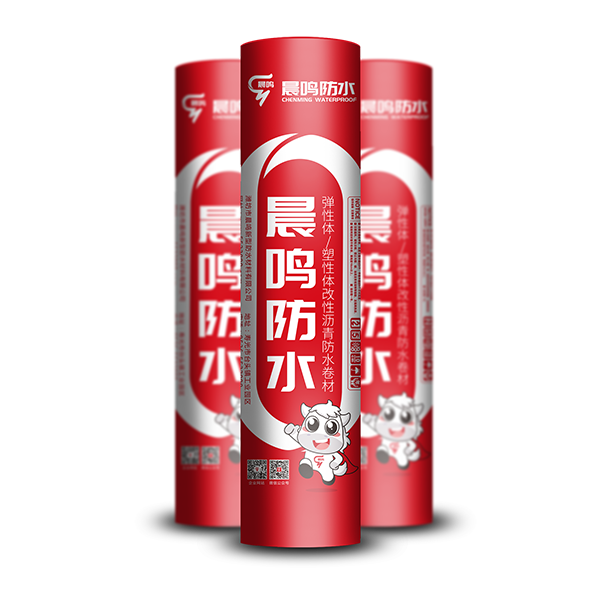
SBS Elastomer Modified Bitumen Waterproofing Membrane
Product Overview
SBS elastomer modified bituminous waterproof waterproofing membrane uses SBS (styrene-butadiene-styrene) thermoplastic elastomer modified bitumen as the impregnating and coating material, high-quality polyester felt, glass fiber felt, glass fiber reinforced polyester felt as the base, and fine sand, mineral granules, PE film, aluminum film, etc. as the covering materials. It is an elastomer modified bitumen waterproofing membrane made by special mechanical stirring and grinding.
APP plastomer modified bitumen waterproofing membrane uses APP (atactic polypropylene) or APAO, APO (polyolefin polymer) modified bitumen as the impregnating and coating material, high-quality polyester felt, glass fiber felt as the base, and fine sand, mineral particles (flakes), PE film as the covering materials. It is a plastomer modified bitumen waterproofing membrane refined by advanced technology.
Product Specifications
- Divided into Type Ⅰ and Type Ⅱ according to physical indicators;
- Divided into three categories according to the base: PY, G, PYG;
- Divided into four categories according to the covering materials: PE film, colored sand, shale flakes, fine sand, etc.;
- Divided into 2mm, 3mm, 4mm, 5mm according to the material thickness.
Product Features
- Strong water impermeability;
- High tensile strength, large elongation, good dimensional stability, and strong adaptability to the shrinkage, deformation and cracking of the base;
- Good high and low temperature resistance. SBS is suitable for building waterproofing in low temperature environments, and APP is suitable for building waterproofing in high temperature environments;
- Good puncture resistance, tear resistance, fracture resistance, corrosion resistance, mildew resistance and weather resistance;
Convenient construction. The hot-melt method can be operated in all seasons, and the joints are reliable.
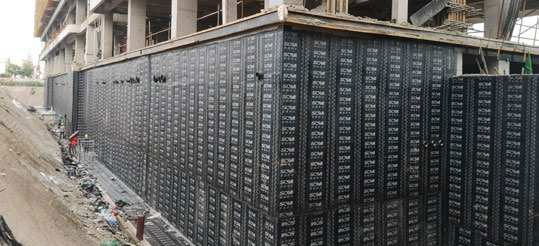
Construction Technology
Hot-melt Method, Cold Adhesion Method and Combined Hot and Cold Method
The membrane can be constructed by hot-melt method or cold adhesion method alone, or by the combined hot and cold method, that is, the large area is constructed by cold adhesion method, and the lap joint is constructed by hot-melt method.
Hot-melt method: Use a flame spray gun or torch to bake the bottom surface of the membrane and the surface of the base, so that the bitumen on the surface of the membrane melts. While baking, roll the membrane forward, and then roll it with a pressure roller to make it firmly bond with the base or the membrane.
Cold adhesion method: First, evenly apply the adhesive on the waterproof layer and the membrane, let it dry slightly, then paste the membrane, and then roll it with a pressure roller to squeeze out the air under the membrane, so that the membrane is flat, tight and firmly pasted on the base or the membrane.
Construction tools and auxiliary materials
Construction tools for cleaning the waterproof base: shovel, broom, dust blower, hammer, steel chisel, etc.
Construction tools for membrane paving: scissors, tape measure, line snapping box, scraper, brush, pressure roller.
Special hot-melt tools: single-head or multi-head hot-melt spray gun or torch. ○ Auxiliary materials: base treatment agent, membrane adhesive, closing strip.
Membrane Paving
Before construction, the accepted base should be cleaned, and the dust at the corners should be blown off.
The base treatment agent should be applied evenly, and should not be applied repeatedly.
After the base treatment agent is dry, first lay the additional layer on the parts that need additional layers in the roof waterproofing project and underground waterproofing project according to the design requirements.
Determine the paving sequence and direction of the membrane and snap lines on the base, then pave the membrane. The bonding of different parts of the membrane shall be constructed according to the following requirements.
Roof: The membrane is point-bonded or strip-bonded to the base; the 800mm around the roof should be fully bonded; · The bonding area of the sloped roof is more than 70%, and the membrane is 100% fully bonded to the membrane;
Basement floor: The membrane can be fully bonded, point-bonded, strip-bonded or empty-laid to the base.
But the membrane must be fully bonded to the membrane. 0 Basement vertical wall: Both the membrane to the base and the membrane to the membrane should be fully bonded;
Additional layer: Generally, it is fully bonded, and empty laying is allowed at the deformation joint.
The paving sequence is first high span, then low span; at the same height, first far then near; roof paving direction:
On the same plane, start paving from the low place.
Slope < 3%: pave parallel to the ridge direction.
Slope 3%~15%: pave parallel or perpendicular to the ridge direction.
Slope > 15% or when subject to vibration, it is advisable to pave perpendicular to the ridge direction. 0 The lap joint parallel to the ridge should be along the water flow direction, and when perpendicular to the ridge, the joint should be paved along the dominant wind direction.
Elastomer modified bitumen waterproofing membrane conforms to GB18242-2008 standard
Main physical and mechanical properties
| Serial Number | Item | Index | ||||
|---|---|---|---|---|---|---|
| Ⅰ | Ⅱ | |||||
| PY | GP | YG | G | PYG | ||
| 1 | 3mm | 2100 | - | - | ||
| 4mm | 2900 | - | - | |||
| 5mm | 3500 | - | - | |||
| 2 | Test phenomenon | - | The base is non-combustible | - | The base is non-combustible | - |
| Heat resistance (℃) ≥ | 90 | 105 | - | |||
| ≤5mm | 2 | |||||
| Test phenomenon | No flowing, dripping | |||||
| 3 | Low temperature flexibility (℃) | -20 | -25 | |||
| 4 | Water impermeability (30min) | 0.3Mpa | 0.2Mpa | - | 0.3Mpa | - |
| 5 | Maximum tensile force (N/50mm) ≥ | 500 | 350 | 800 | 500 | 900 |
| Secondary peak tensile force (N/50mm) ≥ | - | - | - | - | 800 | |
| Test phenomenon | During the stretching process, there is no cracking of the coating layer or separation from the base in the middle of the specimen | |||||
| 6 | Elongation at maximum peak (%) ≥ | 30 | - | 40 | - | - |
| Elongation at secondary peak (%) ≥ | - | - | - | - | 15 | |
| 7 | PE, S | 1.0 | ||||
| Mass increase after immersion (%) ≤ M | 2.0 | |||||
| Tensile force retention rate (%) ≥ | 90 | |||||
| Elongation retention rate (%) ≥ | 80 | |||||
| 8 | Heat aging low temperature flexibility (℃) | -15 | -20 | |||
| Dimensional change rate (%) ≤ | 0.7 | - | 0.7 | - | 0.3 | |
| Mass loss rate (%) ≤ | 1.0 | |||||
| 9 | Oil seepage number of sheets ≤ | 2.0 | ||||
| 10 | Joint peeling strength (N/mm) ≥ | 1.5 | ||||
| 11 | Nail rod tearing strength (N) ≥ | - | - | 300 | ||
| 12 | Mineral aggregate adhesion a (N) ≤ | 2.0 | ||||
| 13 | Thickness of bitumen coating on the lower surface of the membrane (mm) ≥ | 1.0 | ||||
| 14 | Appearance | No flowing, bubbling, dripping | ||||
| Artificial weathering accelerated aging tensile force retention rate (%) ≥ | 80 | |||||
| Low temperature flexibility (℃) | -15 | -20 | ||||
| No cracks | ||||||
a Only applicable to membranes for single-layer mechanical fixation construction. b Only applicable to membranes with mineral aggregate surface. c Only applicable to membranes for hot-melt construction
Plastomer modified bitumen waterproofing membrane conforms to GB18243-2008 standard
Main physical and mechanical properties
| Serial Number | Item | Index | ||||
|---|---|---|---|---|---|---|
| Ⅰ | Ⅱ | |||||
| PY | GP | YG | G | PYG | ||
| 1 | 3mm soluble content (g/m²) ≥ | 2100 | - | - | ||
| 4mm soluble content (g/m²) ≥ | 2900 | - | - | |||
| 5mm soluble content (g/m²) ≥ | 3500 | - | - | |||
| 2 | Test phenomenon c | - | The base is non-combustible | - | The base is non-combustible | - |
| Heat resistance (℃) ≥ | 110 | 130 | - | |||
| ≤5mm | 2 | |||||
| Test phenomenon | No flowing, dripping | |||||
| 3 | Low temperature flexibility (℃) | -7 | -15 | |||
| 4 | Water impermeability (30min) | 0.3Mpa | 0.2Mpa | - | 0.3Mpa | - |
| 5 | Maximum tensile force (N/50mm) ≥ | 500 | 350 | 800 | 500 | 900 |
| Secondary peak tensile force (N/50mm) ≥ | - | - | - | - | 800 | |
| Test phenomenon | During the stretching process, there is no cracking of the coating layer or separation from the base in the middle of the specimen | |||||
| 6 | Elongation at maximum peak (%) ≥ | 25 | - | 40 | - | - |
| Elongation at secondary peak (%) ≥ | - | - | - | - | 15 | |
| 7 | PE, S mass increase after immersion (%) ≤ | 1.0 | ||||
| M mass increase after immersion (%) ≤ | 2.0 | |||||
| Tensile force retention rate (%) ≥ | 90 | |||||
| Elongation retention rate (%) ≥ | 80 | |||||
| 8 | Heat aging low temperature flexibility (℃) | -2 | -10 | |||
| Dimensional change rate (%) ≤ | 0.7 | - | 0.7 | - | 0.3 | |
| Mass loss rate (%) ≤ | 1.0 | |||||
| 9 | Oil seepage number of sheets ≤ | 1.0 | ||||
| 10 | Joint peeling strength (N/mm) ≥ | 1.5 | ||||
| 11 | Nail rod tearing strength (N) ≥ | - | - | 300 | ||
| 12 | Mineral aggregate adhesion b (N) ≤ | 2.0 | ||||
| 13 | Thickness of bitumen coating on the lower surface of the membrane (mm) ≥ | 1.0 | ||||
| 14 | Artificial weathering accelerated aging appearance | No flowing, bubbling, dripping | ||||
| Tensile force retention rate (%) ≥ | 80 | |||||
| Low temperature flexibility (℃) | -2 | -10 | ||||
| No cracks | ||||||
a Only applicable to membranes for single-layer mechanical fixation construction. b Only applicable to membranes with mineral aggregate surface. c Only applicable to membranes for hot-melt construction