






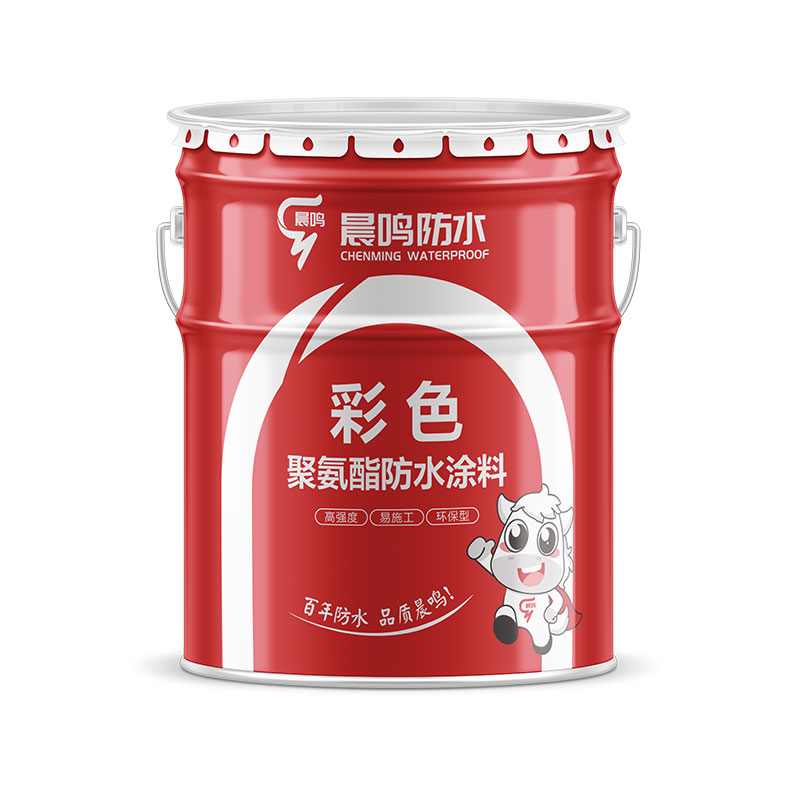
Single-component polyurethane waterproof coating
Product Overview
Two-component polyurethane waterproof coating is a two-component chemical reaction-curing waterproof material. Component A is an isocyanate-terminated prepolymer obtained by the condensation polymerization of polyether and isocyanate. Component B is a colored uniform liquid composed of plasticizer, curing agent, thickener, accelerator, and filler. When in use, mix components A and B in proportion, apply them evenly on the surface of the base layer, and a flexible rubber-like waterproof film will form through chemical reaction to play a waterproof role.
One-component polyurethane waterproof coating is an environmentally friendly one-component waterproof coating with polyurethane polyol as the basic component and non-tar and other harmful substances as curing agents. It cures upon contact with water vapor in the air, forming a flexible and strong waterproof film on the surface of the base layer, which can effectively prevent water penetration and contact with groundwater or corrosive liquids. It has excellent elastic tension, can expand and contract with the deformation such as expansion, contraction and cracking of the base layer, and has excellent performance in resisting any possible structural deformation and shrinkage.
Construction Methods
- Requirements for the base layer: The surface of the base layer shall be solid and flat. When cement mortar is used for leveling, it must be fully cured without looseness, sanding, or peeling. It shall meet the design requirements.
- The treatment of wet surfaces shall be in accordance with the design, instructions for use and treatment requirements.
- The moisture content of the construction surface shall not be greater than 15%.
- After the base layer is cleaned, key parts such as internal and external corners, expansion joints, and construction joints shall be treated.
- For key parts such as deformation joints, prime coat shall be applied in proportion according to the construction requirements to improve the bonding strength and sealing effect.
- After the prime coat is dry, the waterproof coating can be applied by brushing or spraying.
- If the waterproof layer has special design requirements, a fiber-reinforced layer can also be laid according to the design requirements. Before brushing, methods such as spreading coarse sand and other aggregates on the surface of the waterproof layer must be adopted to make its surface rough to facilitate subsequent construction.
- Requirements for the base layer: The base layer shall be dry, flat, and free of debris. Uneven parts and deformation cracks of the base layer must be leveled with cement mortar. Pipes, sanitary facilities, floor drains, etc. connected to the base layer must be installed firmly with tight joints, smooth closures, and no looseness.
- The first coat shall be applied in a consistent direction. After the first coat is cured for 12-24 hours, apply the second coat. Generally, the second coat is applied perpendicular to the first coat, followed by the 2nd-3rd coats, which can be applied by brushing or spraying. To increase the bonding force between the waterproof layer and the rigid protective layer, fine sand is often spread on the surface when it is not fully cured, and after initial curing, the floating sand on the surface is removed before the construction of the rigid protective layer.
- Treatment of detailed structures: Additional waterproof layers shall be applied at details such as internal and external corners, pipe roots, cracks, and deformation joints.
- According to the construction requirements, the film construction can also be completed in one pass, and after curing, the protective layer construction can be carried out.
Performance Indicators
Two-component polyurethane waterproof coating complies with GB/T19250-2013, with main physical and mechanical properties as follows:
| Serial Number | Item | Technical Indicators | ||
|---|---|---|---|---|
| Ⅰ | Ⅱ | Ⅲ | ||
| 1 | Solid content (%) Multi-component ≥ | 92.0 | ||
| 2 | Surface drying time (h) ≤ | 12 | ||
| 3 | Actual drying time (h) ≤ | 24 | ||
| 4 | Leveling property | No obvious flowing after 20min | ||
| 5 | Tensile strength (MPa) ≥ | 2.00 | 6.00 | 12.0 |
| 6 | Elongation at break (%) ≥ | 500 | 450 | 250 |
| 7 | Tear strength (N/mm) ≥ | 15 | 30 | 40 |
| 8 | Low-temperature flexibility | -35℃, no cracks | ||
| 9 | Water impermeability | 0.3MPa, 120min, impermeable | ||
One-component polyurethane waterproof coating complies with GB/T19250-2013, with main physical and mechanical properties as follows:
| Serial Number | Item | Technical Indicators | ||
|---|---|---|---|---|
| Ⅰ | Ⅱ | Ⅲ | ||
| 1 | Solid content (%) One-component ≥ | 85.0 | ||
| 2 | Surface drying time (h) ≤ | 12 | ||
| 3 | Actual drying time (h) ≤ | 24 | ||
| 4 | Leveling property | No obvious flowing after 20min | ||
| 5 | Tensile strength (MPa) ≥ | 2.00 | 6.00 | 12.0 |
| 6 | Elongation at break (%) ≥ | 500 | 450 | 250 |
| 7 | Tear strength (N/mm) ≥ | 15 | 30 | 40 |
| 8 | Low-temperature flexibility | -35℃, no cracks | ||
| 9 | Water impermeability | 0.3MPa, 120min, impermeable | ||
| 10 | Heat shrinkage rate (%) ≤ | -4.0~+1.0 | ||
Product Features
- The one-component product can be directly constructed on the surface of a damp base layer, with fast construction speed, which can shorten the construction period.
- High strength, high elongation, high elastic recovery rate, and strong adaptability to base layer cracking.
- Excellent low-temperature flexibility.
- The coating is dense, without pinholes or bubbles, and has a small water vapor permeability coefficient. It can not only be waterproof but also block water vapor. The color can be adjusted to meet the personalized requirements of different customers for surface colors.
- One coating can reach a thickness of 1-3mm without forming.
- The two-component coating forms a seamless and complete elastic waterproof layer through cement hydration and curing. Its film has high strength and extensibility, which cannot be achieved by卷材 waterproofing. In particular, it has the adaptability that the film can extend with the cracking of the waterproof base layer and elastic substrate base layer.
- It has strong adhesion to the base layer. The waterproof coating has good adhesion to concrete, wood, metal, ceramics, stone, and other high polymers, and can also be used as a bonding layer.
- Two-component polyurethane coating is a cold-applied waterproofing material. During application, simply mix components A and B in the specified ratio and brush onto the waterproofing substrate. Two-component polyurethane coating is a cold-construction waterproof coating. During construction, it is only necessary to mix components A and B in proportion and apply them on the waterproof base layer.
- Local repair of easily leaking detailed structure parts can still achieve the original waterproof effect, saving time, labor, and cost.
- It is an environmentally friendly product with little odor, reducing harm to people and the environment, and is an ideal substitute for tar-type materials.